
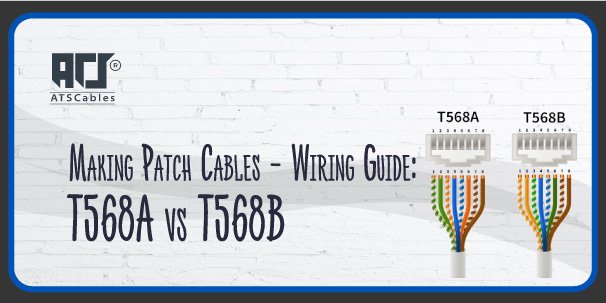
Making Patch Cables: T568A vs. T568B Wiring Guide
The cables you choose can make all the difference for your networking setup. One key decision you’ll face is choosing the correct wiring standard for your Ethernet cables. T568A and T568B are the two main wiring schemes used for making patch cables, and while both deliver similar performance, their wiring configurations differ.
So, which one is crucial for ensuring that your cables work seamlessly with your network equipment? In this guide, we’ll break down the key differences between T568A and T568B, explain how to wire them, and help you choose the right one for your setup.
What is TIA-568?
TIA-568, also known as the Telecommunications Industry Association (TIA) standard, governs the wiring schemes for Ethernet cables. It defines how to wire both the connectors (like RJ45 plugs) and the cables themselves.
These standards ensure that all network devices can communicate properly, regardless of manufacturer or cable type. The two primary wiring schemes under the TIA-568 standard are T568A and T568B.
Although they differ in the color-coding of the wires, both configurations offer the same performance. That said, choosing the right one for your needs matters, especially if you’re patching multiple cables or setting up a large network.
Riser Cables and Plenum Cables
When building a network, you’ll come across different types of Ethernet cables. Riser cables are used for vertical runs between floors, while plenum cables are designed for air-handling spaces. Both types are made with fire-resistant materials and meet specific building codes for safety.
T568A vs. T568B: What’s the Difference?
The difference between T568A and T568B is mainly in the order of the color-coded wires inside the cable. This matters when you’re crimping the connectors onto the cable. Here’s a quick look at how the two standards compare:
T568A Wiring Standard:
- Pin 1 – White with Green
- Pin 2 – Green
- Pin 3 – White with Orange
- Pin 4 – Blue
- Pin 5 – White with Blue
- Pin 6 – Orange
- Pin 7 – White with Brown
- Pin 8 – Brown
T568B Wiring Standard:
- Pin 1 – White with Orange
- Pin 2 – Orange
- Pin 3 – White with Green
- Pin 4 – Blue
- Pin 5 – White with Blue
- Pin 6 – Green
- Pin 7 – White with Brown
- Pin 8 – Brown
The key difference is that T568A places the green and orange pairs in a different order compared to T568B. This change affects the pinouts but does not impact the cable’s performance.
Are the Two Types Compatible?
The short answer is yes, T568A and T568B cables are compatible. Both wiring standards use the same physical structure, so as long as you connect the same wiring standard at both ends of the cable, it will work just fine.
The main issue arises when you try to connect different standards at opposite ends—this could cause network performance issues due to incorrect wiring.
If you’re using T568A on one end and T568B on the other, the cable will be considered a crossover cable, used mainly to connect devices like computers directly to each other. In modern networks, crossover cables are less common, as most devices support auto-sensing of the cable type.
Benefits of Using T568A or T568B
Both T568A and T568B are widely accepted, but there are some reasons to choose one over the other. T568A is more commonly used in government and military installations and tends to be the preferred standard in many parts of the world.
On the other hand, T568B is widely adopted in the USA, especially in residential settings and commercial networks. It was used by AT&T in its installations, which helped make it more popular.
Both wiring standards provide the same speed and performance. However, choosing the one that aligns with your existing network setup will save you from unnecessary troubleshooting later on.
How to Wire T568A and T568B
Now that you understand the basic differences, it’s time to put this knowledge into practice. Here’s a general guide for both:
Tools You’ll Need:
- Crimping tool
- RJ45 connectors
- Ethernet cable
- Cable stripper
Steps for T568A:
- Step 1 – Strip about 1-2 inches of the outer jacket of your cable.
- Step 2 – Untwist the four twisted pairs of wires and straighten them.
- Step 3 – Arrange the wires according to the T568A color code.
- Step 4 – Insert the wires into an RJ45 connector, making sure they reach all the way to the front of the connector.
- Step 5 – Use your crimping tool to crimp the connector and secure the wires.
Steps for T568B:
Follow the same steps as above, but use the T568B color code for wiring. Insert the wires into the RJ45 connector and crimp. After crimping, it’s always a good idea to use a cable tester to ensure the cable is wired correctly.
Conclusion
Choosing between T568A and T568B comes down to your specific needs and existing network infrastructure. Once you understand the difference, the rest is straightforward. Both wiring standards offer reliable, high-speed performance, so select the one that best suits your network setup.
If you’re in need of high-quality Ethernet cables and accessories, check out ATS Cables for all your networking needs. Whether you need Cat5e, Cat6, or ethernet patch leads, we’ve got you covered!
T568A vs. T568B Wiring FAQs
What is the difference between T568A and T568B cable?
The main difference lies in the wire color arrangement. T568A places green wires before orange, while T568B does the opposite. Both standards offer identical performance.
What are 568A and 568B used for?
Both T568A and T568B are used to wire Ethernet cables (Cat5, Cat6, etc.). They ensure proper signal transmission between devices by connecting to RJ45 connectors.
What is the use of T568A?
T568A is used for wiring Ethernet cables in compliance with the TIA/EIA standard. It’s common in residential and commercial settings, particularly for government installations.
What is the function of the T568B?
T568B is one of the two standards for wiring Ethernet cables. It is commonly used in residential and commercial networks and connects devices through RJ45 connectors.
keep connected
Get updates by subscribe our weekly newsletter