
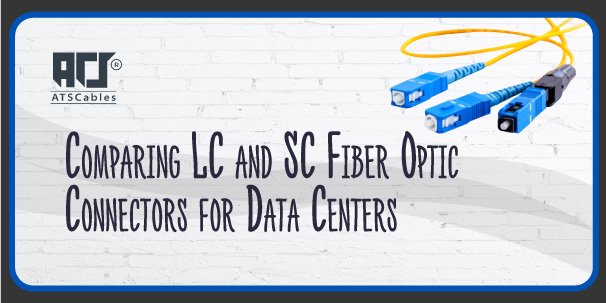
Comparing LC and SC Fiber Optic Connectors for Data Centers
Data centers demand precision and reliability, especially in their cabling systems. With fiber optic cables serving as the backbone, choosing the right connectors is vital. The LC Fiber Optic Connector and SC Fiber Optic Connector are two commonly used options, each with its strengths and specific applications.
So, what are LC fiber optic connectors and SC fiber optic connectors? What are the key differences between both of them? And which one should you choose for data centers? This article dives deep into these connectors, providing clarity for your data center needs.
What is an LC and SC Fiber Connector?
An LC fiber connector uses a small form-factor design, ideal for high-density applications. The SC fiber connector is larger, offering robust connections and simple push-pull coupling. Here is a brief overview to give you a better understanding of the LC and SC fiber optic connector.
LC Fiber Optic Connector
The LC fiber optic connector is a small form-factor connector that excels in high-density setups. Its RJ45-style latch makes it easy to secure, and its compact size allows for efficient space utilization. This connector is commonly found in modern data centers and telecom environments.
SC Fiber Optic Connector
The SC fiber optic connector is slightly larger and is known for its durability and simplicity. It uses a push-pull mechanism, ensuring quick connections and disconnections. SC connectors are favored in environments requiring robust connections, such as broadcast networks.
Choosing the Right Connector for Your Data Center
The decision between LC fiber optic connectors and SC fiber optic connectors is critical for ensuring seamless operations in your data center. Each connector type has its unique advantages, and the best choice often depends on the specific requirements of your infrastructure. Here’s a detailed guide to help you decide.
Space and Port Density
In data centers where space is at a premium, the LC fiber optic connector is often the preferred choice. Its compact size allows for high port density, meaning more connections can be accommodated in a smaller area. This is particularly important in environments like server rooms and modern data centers, where maximizing efficiency is crucial.
On the other hand, SC connectors are larger and may not be as space-efficient. However, in setups where density is not a concern, such as broadcast facilities or industrial networks, SC connectors are often a reliable option.
Durability and Longevity
If your application involves heavy usage or exposure to environments where cables may be frequently plugged and unplugged, SC connectors might be the better choice. Their push-pull mechanism is not only easy to use but also highly durable, ensuring a longer lifespan for the connection.
LC connectors, while durable, are better suited for environments where connections are less frequently disturbed. Their RJ45-style latch is effective but not as rugged as the SC connector’s design.
Cable Management
For data centers that prioritize neat and organized cable management, the LC connector is a winner. Its small size and lightweight design reduce cable strain, making it easier to bundle and organize cables efficiently.
This is particularly beneficial for large-scale deployments, where poorly managed cabling can lead to significant challenges in maintenance and troubleshooting.
Connection Requirements
If your data center requires a high number of connections in a small area, LC connectors are the go-to option. Their compact design ensures efficient use of space.
On the other hand, if your environment demands a connection that can withstand frequent handling, SC connectors provide a sturdy and reliable solution.
Future-Proofing Your Network
As data demands grow and technology evolves, ensuring your data center is future-ready is essential. LC connectors have a space-saving design. Therefore, they are often better suited for the increasing need for higher port density in advanced networking equipment.
SC connectors, while slightly older in design, remain a dependable option for specific use cases that prioritize durability over density.
The Role of Fiber Optic Cables
Fiber optic cables are the backbone of modern data centers, enabling high-speed and reliable data transmission across vast distances. Unlike traditional copper cables, they use light to transmit data. As a result, it offers top-notch performance in terms of speed, bandwidth, and signal integrity.
The choice of connectors, such as LC Fiber Optic Connectors or SC Fiber Optic Connectors, directly impacts the efficiency and performance of these cables. Here are a few benefits of Fiber optic cables:
- High Bandwidth – Fiber optic cables support significantly higher bandwidth compared to copper alternatives, making them ideal for the demands of modern data centers.
- Minimal Signal Loss – Light signals in fiber optic cables experience minimal attenuation, ensuring consistent data quality over long distances.
- Immunity to Electromagnetic Interference – Fiber optic cables are resistant to interference from nearby electronic devices or power lines, ensuring a stable connection in challenging environments.
- Scalability – Fiber optic infrastructure is future-proof, capable of handling increasing data loads as technology advances.
Final Words on LC and SC Fiber Optic Connectors
In summary, both LC Fiber Optic Connectors and SC Fiber Optic Connectors are reliable, efficient, and critical in maintaining high-performance data centers. Choosing the right one depends on your specific requirements, from density to durability.
If you’re looking for premium-quality cables and connectors, check out ATS Cables for industry-leading solutions tailored to your data center needs. You can find the best cabling solutions at the best price according to your needs.
FAQs
What is an LC and SC fiber connector?
An LC fiber connector is a compact connector designed for high-density applications. An SC fiber connector is larger, durable, and uses a push-pull coupling mechanism for simple and robust connections.
What is an LC fiber connection?
An LC fiber connection refers to the use of an LC connector, which features a small form factor and a secure latch mechanism, ensuring reliable and space-efficient fiber optic connections.
What is the difference between LC and SC simplex cable?
The primary difference lies in size and locking mechanisms. LC simplex cables use smaller connectors with a latch mechanism, while SC simplex cables are bulkier and feature a push-pull design.
What is the full form of LC and SC in networking?
LC stands for Lucent Connector, and SC stands for Subscriber Connector.
keep connected
Get updates by subscribe our weekly newsletter